
Acupressure Points for Neck Pain Relief:
Most of us spend the whole workday on a computer or phone now, and our necks pay for it. Your neck moves your head all day long, so it’s quick to complain. Once it stiffens up, even simple things like turning to check traffic or looking down at your phone get hard.

The good news? A few well-chosen acupressure points for neck pain relief can ease headaches, shoulder pain, and neck pain. Most of these points sit around the head and neck (the Yang points). You can work them with a free hand whenever you get a minute, and they really do help.
Acupressure Points for Neck Pain Relief:
You don’t have to use every point. Just pick the ones you can reach comfortably.
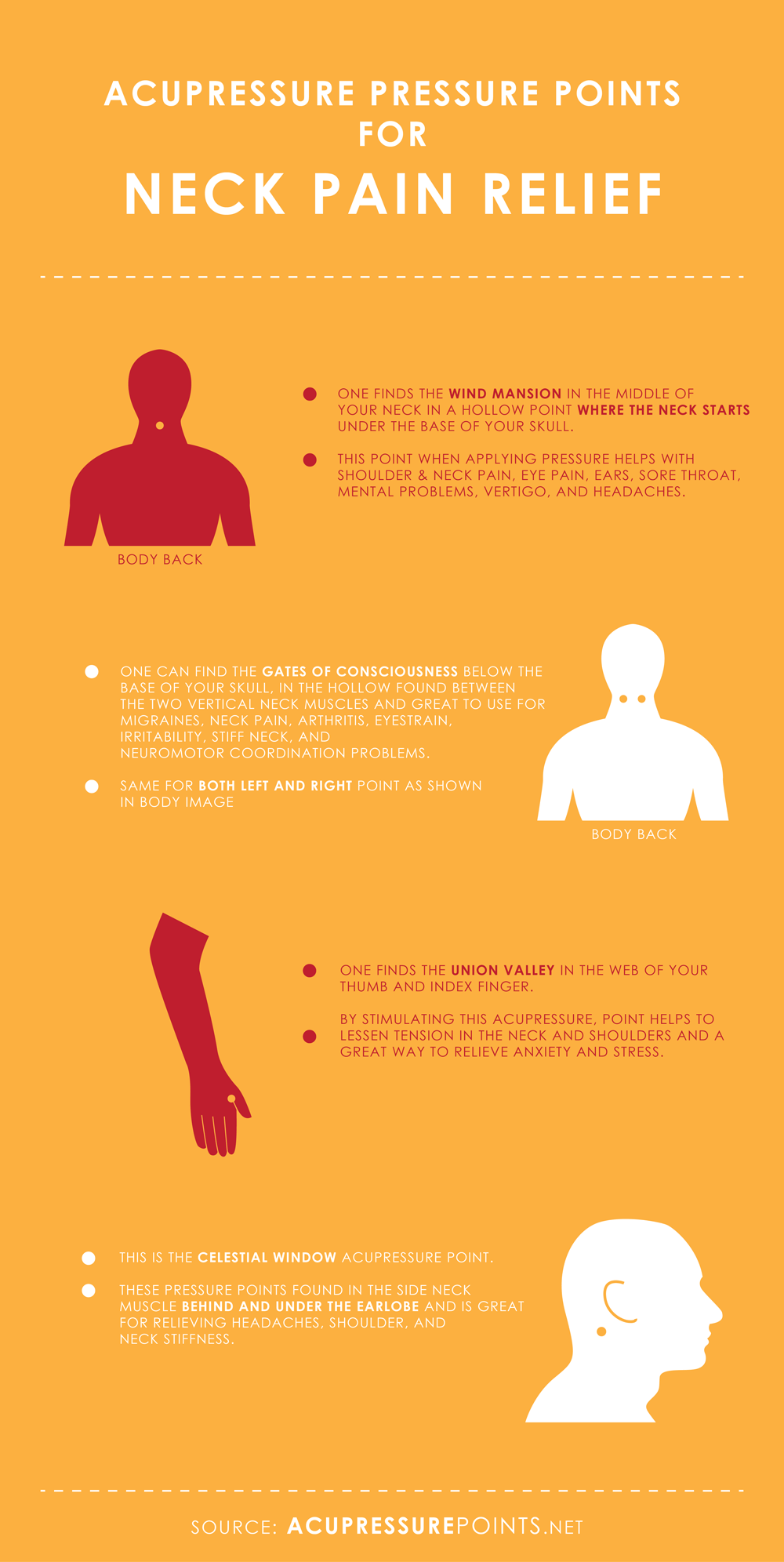
Acupressure Points for Neck Pain Relief Infographic:
Take Care of Your Neck and Shoulders:
Think about a normal workday. You’re stressed, parked in front of a desktop, laptop, or phone, staring at the screen and barely moving. Do that for hours and your shoulders creep up, your neck locks, and by evening it hurts.

Poor sitting posture causes a lot of this. So do muscle strain, overdoing it, sprains, and sleeping in a bad position. You end up sore, sometimes numb, across the neck and shoulders. However, applying some pressure and doing simple exercises for a few days can often help it feel better.
Check out this: Acupressure Points for Weight Loss – Works in 1-2 Weeks
But if the pain drags on for weeks, spreads into your back, or starts causing headaches, see your doctor instead.
Reflexology Points for Relieving Neck Pain:
For many of us, neck and shoulder pain gets in the way of daily life, and the first thing most of us do is reach for painkillers. Pressure points offer a drug-free way to ease the pain and help you feel better overall.

Before the points themselves, one rule: press gently, with your fingertips. Working on someone else? Ask if the pressure feels okay and stop if it hurts. Most of these points exist on both sides of the body, so you can do both. Hold each one for 2–3 minutes, then move to the next if you need to.
More information about Acupressure Points for Constipation
Here are the points I reach for most for neck pain:
The Head:
The Drilling Bamboo
You’ll find Drilling Bamboo in the little groove on either side where the bridge of your nose meets your eyebrow ridge. It helps with neck pain, headaches, tired eyes, sinus pain, and hay fever.

Seven more points in this area can help with neck pain too, and you can use them together for arthritis, frontal headaches, and neck pain: eyebrow ascension, deviating turn, fifth place, light guard, celestial connection, declining connection, and the jade pillow.
Neck Region:
The Wind Mansion

Wind Mansion sits in the hollow at the back of your neck, right under the base of your skull. Press it for shoulder and neck pain. It also helps with eye pain, earaches, a sore throat, mental fatigue, vertigo, and headaches.
Check this Also: Acupressure Points to Induce Labor
The Celestial Window

Look for these in the side of the neck muscle, behind and just under the earlobe. They’re good ones for headaches and for stiffness in the shoulders and neck.
The Gates of Consciousness

The Gates of Consciousness sit below the base of your skull, in the hollows between the two vertical neck muscles. Use them for migraines, neck pain, arthritis, eyestrain, irritability, a stiff neck, and Neuromotor coordination problems.
The Window of Heaven

Window of Heaven is in the groove at the base of your skull, roughly one to two inches behind your earlobe. Pressing here can ease neck and shoulder pain, headaches, and a stiff neck.
The Heavenly Pillar

Heavenly Pillar sits on those ropy muscles about 1 ½ inches below the base of your skull, just out to the side of the spine. It’s a hard-working point. People use it for exhaustion, stress, eyestrain, a sore throat, a stiff neck, insomnia, and headaches.
The Shoulder Well

Shoulder Well is at the highest point of the shoulder muscle, about two inches out from the lower neck. It eases nervousness, fatigue, irritability, and shoulder tension. On a pregnant woman, press lightly at this pressure point.
The Union Valley, on the Hand

Union Valley is in the webbing between your thumb and index finger. Working this point loosens neck and shoulder tension, and it’s a good one for anxiety and stress too.
Mother Nature at Its Best
People have rubbed herbal preparations on sore muscles for centuries. Alongside your acupressure therapy, try these on the sore spots:
- Menthol and Camphor show up in most over-the-counter rubs for muscle and joint pain. You can also rub the distilled oils straight into the skin. They bring more blood to the sore area and give a warm, sometimes cool, feeling while the muscles relax.
- Lavender comes as a fragrant essential oil. Massage it into the sore area, on its own or along with reflexology. Lavender works well on neck pain and other muscle aches.
Acupressure Therapy has come a long way.
People have used acupressure for centuries, for all sorts of aches and complaints. Work these points for a few minutes and you’ll feel why it has lasted. Your neck eases off, your head clears, and the day feels manageable again.
Medically reviewed by Dr. Jian Times
Last updated: October 22, 2026